

Nature Cure vs Intermittent Fasting: What’s the Difference — and Where Does Sports Nutrition Fit?

Fasting is having quite the comeback.
Depending on where you look, it is being promoted for weight loss, insulin sensitivity, metabolic health, healthy ageing, gut health, inflammation, longevity and just about everything in between.
But fasting itself is certainly not new.
Long before intermittent fasting became a popular nutrition strategy, fasting was already part of traditional naturopathic Nature Cure. And while the two approaches can look similar from the outside — both involve periods of not eating, after all — they come from quite different philosophies and are often used for different reasons.
As a naturopath and sports nutritionist, I find this distinction really important.
I’m not particularly interested in fasting as a trend, or in telling everyone that they need to stop eating at a certain time because a study or influencer says so. I’m much more interested in why we are using fasting, what we are trying to achieve, who we are using it with, and what else is happening in that person’s body and life.
That is where things become much more useful clinically.
What is Nature Cure fasting?
Nature Cure grew from the European natural healing movement of the nineteenth century and became one of the foundations of modern naturopathic medicine. Early Nature Cure practitioners worked with approaches such as hydrotherapy, fresh air, movement, diet, rest and periods of reduced food intake or fasting. Historical records show that fasting and dietary restriction were incorporated into some European naturopathic treatment systems, although there was never one universal “Nature Cure fast”.
Traditional Nature Cure generally viewed fasting as part of a broader therapeutic process, rather than simply as a way to reduce calories.
Historical practitioners spoke about giving the digestive system a rest, reducing the burden of food for a period of time and allowing the body to direct its resources towards recovery. Some systems used complete fasting, while others used modified approaches such as juice fasting or mono-food fasting. The language used historically — around “toxins”, “elimination” and “purification” — also reflects the medical thinking of the time and does not always translate neatly into modern physiology. Even Henry Lindlahr, an influential Nature Cure writer, described fasting as something that could potentially help or harm depending on the circumstances rather than as a universal cure.
That distinction matters.
When I look at traditional fasting now, I think there is value in understanding what practitioners were attempting to achieve, while also separating historical theory from what we can actually support with contemporary nutritional and physiological evidence.
Nature Cure also encompasses approaches such as:
- water fasting
- European-style juice fasting
- green juice fasting
- mono-food fasting
- periods of simplified eating
- dietary rest combined with other lifestyle therapies.
So when someone says “fasting”, we really need to ask: which fasting?
Because drinking vegetable juice for several days is physiologically very different from consuming nothing but water, and both are very different again from simply eating dinner at 6 pm and breakfast at 8 am.
Then along came intermittent fasting
Modern intermittent fasting comes from a rather different direction.
Instead of primarily being framed as a therapeutic Nature Cure practice, intermittent fasting is usually studied as a meal-timing or energy-restriction strategy.
There are several variations, including:
- time-restricted eating, where food is consumed within a set daily window
- alternate-day fasting
- modified fasting days
- approaches such as 5:2 fasting
- longer daily fasting periods such as 16:8.
And this is where the terminology gets a little messy.
A person who finishes dinner at 7 pm and has breakfast at 7 am has technically had a 12-hour overnight fast. Someone following a 16:8 plan may eat between midday and 8 pm. Someone following alternate-day fasting may dramatically reduce energy intake every second day.
These are all grouped under the fasting umbrella, but they are not metabolically identical.
What does the modern research actually tell us?
There is now a considerable amount of research looking at intermittent fasting and time-restricted eating, particularly in relation to body weight, glucose regulation and cardiometabolic health.
Some studies have found improvements in body weight, insulin sensitivity and metabolic markers, particularly in people who are overweight or have metabolic dysfunction. For example, research in adults with metabolic syndrome has found that time-restricted eating can produce modest improvements in glycaemic control and other cardiometabolic outcomes.
That does not mean fasting is automatically superior to other nutritional approaches.
One of the big questions in fasting research is whether the benefits come specifically from the fasting window or simply because people often eat less overall when their eating window becomes shorter.
And clinically, I think that is an important distinction.
If someone stops grazing from breakfast until bedtime, reduces late-night eating and becomes more aware of what they are consuming, they may feel substantially better. But that does not necessarily mean that a 16-hour fast has some magical metabolic property that everybody needs.
Sometimes simply creating more structure around meals can be useful.
This is where sports nutrition changes the conversation
If I am looking at fasting through a sports nutrition lens, my first question is not: “How long can this person fast?”
It is: “What does this person need to fuel?”
An athlete is not metabolically sitting still.
Training creates a substantial demand for carbohydrate, protein, fluid, micronutrients and total energy. The harder and more frequently somebody trains, the more careful we need to be about compressing all of that nutrition into a shorter eating window.
This is particularly relevant with endurance athletes, people training twice a day, athletes trying to build muscle and anyone already struggling to eat enough.
The International Olympic Committee defines low energy availability as an imbalance where dietary energy intake is insufficient relative to the energy being expended through exercise, leaving too little energy available for normal physiological function. Persistent problematic low energy availability can contribute to Relative Energy Deficiency in Sport, or REDs, affecting areas including reproductive function, bone health, immunity, glycogen synthesis, metabolism and sporting performance.
This is why I become cautious when athletes begin stacking strategies on top of each other:
fasting + calorie restriction + low carbohydrate + high training volume + a desire to lose weight.
That combination can become problematic quite quickly.
In my own sports nutrition work, I have long emphasised that fasting needs to work around the person’s training and recovery, not the other way around. If somebody trains fasted and then continues fasting for hours afterwards, they are extending the period in which the body has had an increased physiological demand without supplying the nutrients needed for recovery.
Fasting and training are not automatically incompatible
This is not me saying athletes can never fast.
They can.
Some people genuinely feel good training before breakfast. Some shorter, lower-intensity sessions may be perfectly compatible with an overnight fast. There may also be specific situations where practitioners deliberately manipulate nutrient availability as part of a structured training programme.
But context matters enormously.
A relaxed 45-minute walk before breakfast is not the same physiological situation as:
- a 90-minute endurance session
- interval training
- a heavy strength session
- a long run
- back-to-back training sessions
- preparation for a major event.
The greater the training demand, the more important fuel timing becomes.
Research also supports this broader view. The IOC's latest REDs consensus highlights not only low overall energy availability but the potential compounding role of low carbohydrate availability in athlete health and performance.
That is very relevant when intermittent fasting starts reducing opportunities to eat carbohydrate around training.
But doesn’t fasted training make us better fat burners?
This is another area where the answer is: yes... but also, it depends.
Training with lower carbohydrate availability can increase fat oxidation during exercise. Endurance athletes can become very efficient at using fat as fuel.
But increased fat burning during a session is not automatically the same thing as improved performance or greater body-fat loss over time.
Carbohydrate remains incredibly important when intensity rises. Higher-intensity work relies heavily on glycogen and glucose, so constantly training under-fuelled can compromise the quality of the training session.
This is one of the traps I see in sports nutrition: people become so focused on burning more fat during exercise that they forget the actual purpose of training.
If your goal is to run faster, lift heavier, recover properly or adapt to training, sometimes eating before training is exactly what helps you do that.
What about body composition?
Time-restricted eating combined with exercise has been studied for its potential effects on body composition.
Recent systematic reviews suggest it may lead to modest reductions in body weight or fat mass while generally preserving physical performance when energy and protein intake remain adequate. But results are variable, studies are often relatively short, and the participants are not always representative of serious athletes with high training loads.
That last point is worth remembering.
A nutrition strategy working in recreationally active adults does not automatically mean it is ideal for a female endurance athlete running 80 kilometres per week.
We always have to look at who was actually studied.
Women deserve a separate conversation
Women are one group where I am particularly careful with fasting.
Not because women are somehow incapable of fasting, but because reproductive function is sensitive to energy availability, particularly when high exercise loads, dietary restriction and physiological stress are added together.
Low energy availability in active women is associated with menstrual dysfunction, impaired bone health, poor recovery and other metabolic consequences.
More recent reviews of intermittent fasting also point towards a need for sex-specific interpretation. Responses appear to vary depending on baseline metabolic health, reproductive stage, fasting protocol, training demands and whether adequate energy is still being consumed overall. Research comparing men and women directly remains limited.
This is also consistent with what I teach around female performance nutrition: long fasting periods, skipped meals and low carbohydrate intake can become red flags when they sit alongside high training loads, fatigue, poor recovery or menstrual disruption.
So again, I come back to individualisation.
A sedentary post-menopausal woman with insulin resistance is not the same clinical picture as a lean 25-year-old endurance athlete training six days a week.
Calling both of them “women doing intermittent fasting” tells us almost nothing useful.
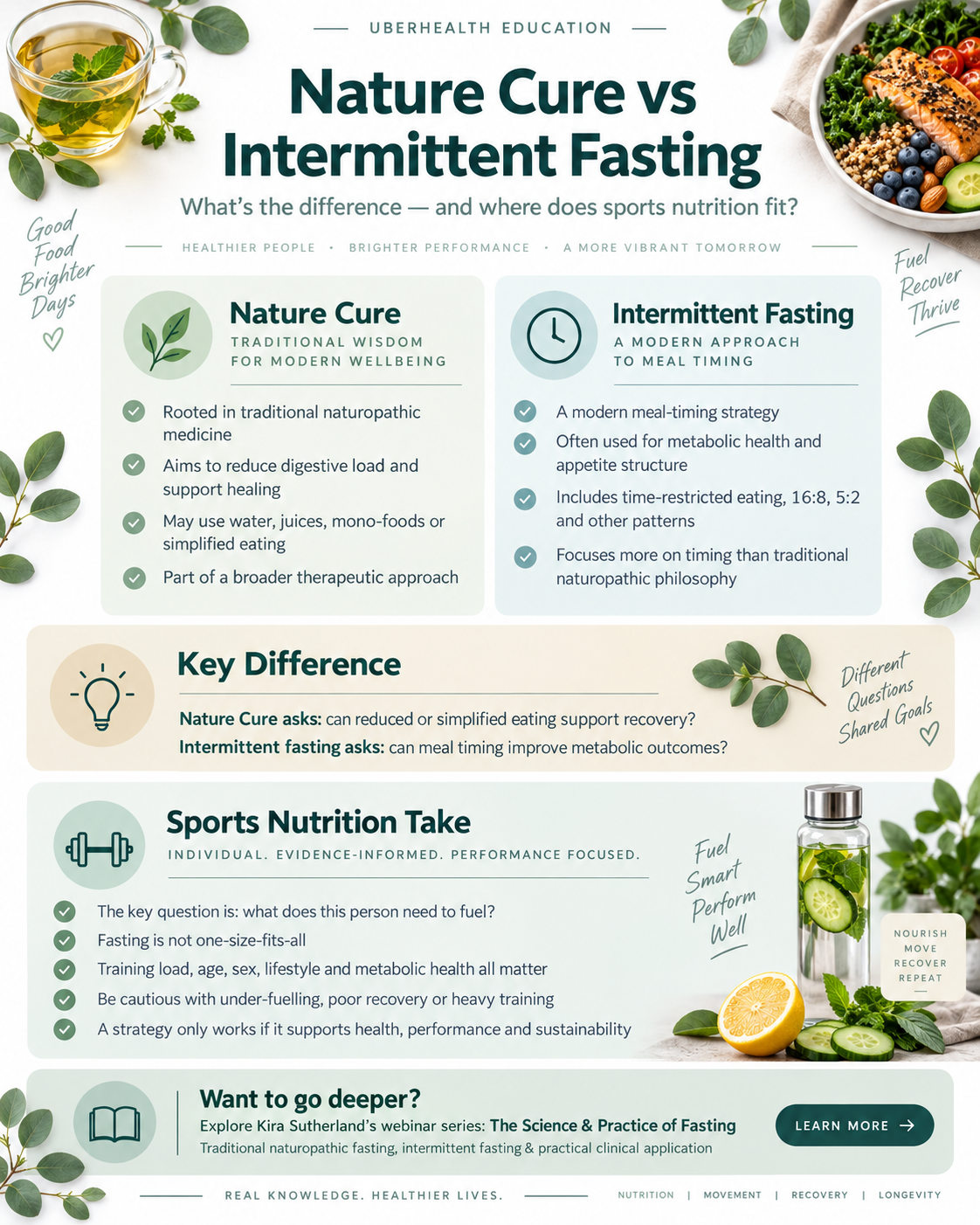
Nature Cure and intermittent fasting are asking different questions
This is probably the biggest difference for me.
Traditional Nature Cure asks:
Can temporarily reducing or simplifying food intake form part of a broader therapeutic strategy?
Modern intermittent fasting asks:
Can manipulating the timing of food intake affect energy balance, metabolism and health?
Those questions overlap, but they are not identical.
Nature Cure fasting historically sits within a wider philosophy involving rest, diet, hydrotherapy and lifestyle.
Intermittent fasting is more often studied through measurable metabolic outcomes such as:
- body weight
- glucose
- insulin
- lipids
- blood pressure
- inflammatory markers.
The interesting part is bringing those two worlds together without pretending that either one has all the answers.
Where I think fasting can become useful
I tend to think about fasting as a tool, not a dietary identity.
There are situations where creating a defined overnight fasting period may help someone stop mindless evening grazing.
Some people find time-restricted eating simplifies their day.
Someone with metabolic dysfunction may respond well to carefully structured meal timing.
Some clients may find that a moderate fasting window improves their appetite awareness and makes eating feel less chaotic.
And traditional fasting methods can also be interesting to examine clinically, particularly when we understand their historical context rather than simply copying old protocols unquestioningly.
But the usefulness of any fasting method depends on what happens to the person using it.
If energy improves, metabolic markers improve and eating remains nutritionally adequate, that is one picture.
If fasting produces fatigue, poor training, sleep disruption, binge eating, menstrual changes or a constant battle with hunger, that is a very different picture.
When I become cautious
From a sports nutrition perspective, I become particularly cautious where there is:
- high training volume
- inadequate total energy intake
- low carbohydrate availability
- poor recovery
- menstrual irregularity
- repeated injuries
- declining performance
- a history of restrictive eating
- pregnancy or breastfeeding
- significant medical conditions or medications that affect glucose regulation.
The IOC's current position on REDs makes it very clear that prolonged or severe low energy availability can impair multiple physiological systems and performance.
Fasting is not automatically responsible for low energy availability.
But it can certainly make it easier to get there if somebody has a large energy requirement and suddenly gives themselves eight fewer hours in the day to meet it.
Sometimes the issue is not the fasting window itself. It is simply that the person cannot physically fit enough nutrition into the remaining hours.
We also need to stop treating longer as better
This is another thing that tends to happen with fasting.
Someone starts with 12 hours.
Then it becomes 14.
Then 16.
Then they start wondering whether 18 is even better.
Nutrition does not work like collecting frequent-flyer points.
A longer fasting window is not automatically healthier.
There is a point where restricting the eating window may begin compromising protein distribution, carbohydrate availability, training nutrition, total energy intake or simply someone's ability to have a normal social life.
And if we are working with athletes, protein distribution across the day matters as well. Compressing all meals into a very narrow period may not be the most practical approach if we are also trying to provide repeated opportunities for muscle protein synthesis and effective recovery.
The question is not “Nature Cure or intermittent fasting?”
For me, that is the wrong argument.
Traditional Nature Cure gives us historical context and a different way of thinking about therapeutic rest and food intake.
Modern intermittent fasting research gives us increasingly useful information about meal timing, metabolic health and energy regulation.
Sports nutrition adds another essential layer:
What happens when we ask the body to perform?
Once training enters the picture, fasting cannot be considered separately from:
- energy availability
- carbohydrate availability
- protein intake
- recovery
- hormonal health
- training volume
- sleep
- body composition goals
- the athlete's life outside sport.
And this is why fasting becomes far more interesting — and far more complex — than simply choosing a fasting window.
Want to go deeper into fasting?
The Science & Practice of Fasting, is my two-part webinar series for health practitioners, students and anyone wanting a more clinically useful understanding of fasting.
In Part 1: Traditional Fasting & Nature Cure, we look at the history and philosophy of fasting within naturopathic practice, including water fasting, European-style juice fasting, green juice fasting, mono-food approaches and how these traditional methods may — or may not — fit within modern practice.
Then in Part 2: Intermittent Fasting & the Modern Evidence, we move into time-restricted eating, intermittent fasting protocols, current research, proposed metabolic effects and the individual factors that change whether fasting is appropriate.
Most importantly, we bring both sides back to clinical practice.
Because there is already plenty of information telling us what fasting is.
The much harder — and much more useful — question is:
What do we actually do with this information when there is a real person sitting in front of us?

FREE RESOURCE
PROTEIN & CARB GUIDE
