

Fasting or Simply Not Eating Enough? How Practitioners Can Spot The Difference

Intermittent fasting can look very tidy on paper. A defined eating window. Fewer snacks. Less late-night eating. Maybe some weight loss and an improvement in blood glucose. For some clients, it can be a genuinely useful strategy. But there is another scenario I see clinically, particularly when exercise is involved.
A client tells you they are “fasting”, but when you actually look at their day they are skipping breakfast, training on empty, eating a fairly light lunch, restricting carbohydrates, trying to lose weight and then wondering why they are tired, hungry, cold, not recovering and suddenly performing worse.
At that point, I become much less interested in the fasting window and much more interested in whether this person is eating enough overall.
Because fasting and under-eating are not the same thing. And as practitioners, we need to be able to tell the difference.
Fasting describes when someone eats.
Under-eating describes whether they are meeting their fuelling needs.
This is probably the simplest place to start.
Intermittent fasting is essentially an eating pattern. It changes the timing of food intake by creating defined periods of eating and not eating.
That does not automatically mean somebody is eating too little.
A person could comfortably consume adequate energy, protein, carbohydrates, fats and micronutrients within a 10-hour eating window and feel very well doing it.
Another person could use exactly the same eating window and end up consuming substantially less food than their body requires.
That second scenario becomes particularly important when exercise energy expenditure is high.
In sports nutrition we talk about energy availability — essentially, how much dietary energy remains available for normal physiological functioning after the energy cost of exercise has been accounted for.
Problematic low energy availability can occur when energy intake does not adequately cover both training expenditure and the body's other physiological needs. When this becomes prolonged or significant, it can contribute to Relative Energy Deficiency in Sport, or REDs, which can affect metabolic, reproductive, musculoskeletal, immune, cardiovascular and psychological health as well as sporting performance.
Importantly, this affects both women and men.
So when I am looking at a client's fasting routine, the first question isn't: “How many hours are they fasting?”
It is: “Can they still adequately fuel everything they are asking their body to do?”
A fasting window isn't automatically a problem
There is an important bit of balance needed here. Intermittent fasting and time-restricted eating are not automatically detrimental to athletes or active people.
Research in exercising adults has found that time-restricted eating can reduce body mass and fat mass without necessarily reducing many measures of physical performance. A 2024 systematic review of regularly exercising adults also found that time-restricted eating could produce changes in body composition without clear overall impairment in physical performance.
So I wouldn't look at a client using intermittent fasting and immediately assume there is a problem.
What I want to know is what happens after they start doing it.
Are they still eating enough?
Are they training well?
Are they recovering?
Are they sleeping?
Are they maintaining muscle?
Are their menstrual cycles stable?
Do they have enough energy to get through their normal life as well as their exercise?
That is where the real clinical information sits.
The 1st clue: the fasting window keeps getting longer
One thing I watch is how fasting evolves.
A client may start with a perfectly reasonable overnight fasting period — dinner at 7 pm and breakfast at 7 or 8 am.
Then breakfast gets pushed to 10 am.
Then midday.
Then they decide that if 16 hours is good, perhaps 18 hours is better.
Meanwhile, exercise is still happening.
This is where fasting can quietly become restriction.
There is no prize for accumulating fasting hours. Longer does not automatically equal healthier. If extending the fasting period makes it increasingly difficult for somebody to consume enough food during their remaining eating window, we need to question whether the strategy is still serving them.
Look at what happens around training
This is one of the biggest giveaways for me as a sports nutritionist.
Ask: When do they train?
Then ask: When do they eat?
Those two answers often tell you a lot.
If somebody does a short, easy session before breakfast and then eats afterwards, that can be very different from somebody who:
- trains hard first thing in the morning
- does it fasted
- continues fasting for another three or four hours
- has a small lunch
- then trains again later that day.
We now have a very different nutritional situation.
In my own sports nutrition teaching, I consistently emphasise recovery nutrition because training uses glycogen and increases the body's nutritional requirements. Post-training carbohydrate and protein help replenish glycogen and support tissue repair and recovery.
There are certainly times where fasted training can be used strategically. But fasted training and prolonged post-training fasting are two separate decisions. If the client's feeding pattern repeatedly removes nutrition from the periods where their body most needs it, that deserves a closer look.
The 2nd clue: performance starts going backwards
Clients sometimes tolerate under-fuelling surprisingly well at first. Especially motivated athletes, they can train through quite a lot. So I don't only ask whether they can complete their training. I want to know whether the quality of that training has changed.
Look for:
- slower running or cycling times
- reduced power
- declining strength
- inability to progress training loads
- previously manageable sessions suddenly feeling very hard
- needing longer to recover
- unusually heavy legs
- reduced concentration during training
- loss of motivation to train
- repeated training plateaus.
A large systematic review and meta-analysis published in 2025 found low energy availability was associated with poorer running performance, endurance, training response, coordination, concentration, judgement, explosive power and agility compared with adequate energy availability.
The IOC also includes performance and training plateaus or declines among the symptoms clinicians may encounter when assessing possible REDs.
Performance data can therefore become very useful clinical information. If somebody's nutrition strategy is supposedly improving their health while their physical capacity is steadily deteriorating, I want to know why.
The 3rd clue: recovery starts taking longer
Recovery gives us another window into energy availability.
Ask:
How does the client feels the day after training. And the day after that.
Do they recover reasonably between sessions, or are they permanently sore?
Are they developing niggles that never quite disappear?
Are they struggling to complete the training volume they previously tolerated?
Do they feel wrecked rather than pleasantly tired after exercise?
Under-fuelling doesn't just mean feeling hungry. The body has to allocate limited resources. If dietary energy is repeatedly insufficient, recovery, tissue repair, immune function and adaptation can all become affected. Some people with chronic restriction stop experiencing hunger in the way we expect. Others become very skilled at ignoring it.
So look at function, not just appetite.
The4th clue: food has become increasingly restrictive
Sometimes the fasting window itself is not the major issue, it is what has accumulated around it.
For example:
Intermittent fasting + low carbohydrate + calorie restriction + high training volume + weight-loss goal.
Each strategy may have a rationale on its own. Stack them together and suddenly the client's available energy can become very low.
In my work with active women, some of the nutritional red flags I look for include skipping meals, long fasting periods, low carbohydrate intake despite significant training, removing multiple food groups and increasingly restrictive eating behaviours.
This is where taking a detailed food history matters.
Ask:
“Talk me through everything you ate yesterday, from when you woke up until you went to bed.”
The 5th clue: carbohydrate disappears
Carbohydrates deserve particular attention in active clients. Fasting discussions often focus almost entirely on total calories and insulin, but for athletes there is another issue: carbohydrate availability. The IOC's updated REDs consensus specifically highlights the emerging role of low carbohydrate availability alongside low overall energy availability: The harder the training intensity, the greater the reliance on carbohydrate as fuel.
So if a client is simultaneously:
- fasting
- eating low carbohydrate
- doing high-intensity sessions
- performing endurance work
- training frequently
there may be a mismatch between fuel availability and training demands.
That doesn't mean every athlete needs huge amounts of carbohydrate every day. It means carbohydrate intake needs to reflect what the athlete is actually doing. This is standard sports nutrition: match input to the output.
The 6th Clue: women start reporting menstrual changes
For premenopausal women, menstrual function provides extremely useful clinical information.
A cycle changing does not automatically mean low energy availability. There are many possible causes and they need appropriate investigation. But menstrual changes alongside restrictive eating and high training volume deserve attention.
Ask about:
- cycles becoming longer or increasingly irregular
- missed periods
- changes in bleeding
- changes in PMS
- reduced libido
- changes that began after increasing training, dieting or fasting.
Low energy availability can disrupt reproductive function, and menstrual disturbance remains an important part of REDs assessment in female athletes. This is one reason I am particularly cautious when fasting advice is applied to women without considering reproductive stage, training volume and total energy intake.
A woman in perimenopause with insulin resistance and a relatively low training load presents a very different clinical picture from a 25-year-old endurance athlete training six days per week.
The 7th clue: injuries and illness become more frequent
Repeated injuries always make me curious. Especially bone stress injuries.
Problematic low energy availability has been linked with impaired bone health, and the 2025 meta-analysis found athletes with low energy availability had poorer bone health and greater risk of bone stress injuries across much of the literature reviewed.
So ask about illness.
Is the client suddenly catching every cold going around?
Are they repeatedly missing training because they are unwell?
Is recovery from illness slower?
Again, none of these signs diagnoses under-fuelling by itself.
We are looking for the pattern.
The 8th clue: everyday energy changes
Not every symptom will be sporting. Some of the most useful questions are very ordinary:
How do you feel at 3 pm?
Are you freezing when everyone else is comfortable?
How is your concentration?
Are you thinking about food all day?
How are you sleeping?
How is your mood?
Clients may report:
- persistent fatigue
- dizziness or light-headedness
- cold hands and feet
- poor concentration
- irritability
- reduced libido
- disrupted sleep
- persistent hunger or food preoccupation
- strong sugar cravings.
Many of these symptoms are non-specific, so they require proper differential assessment rather than being automatically blamed on fasting. But when several appear together after somebody has substantially restricted their eating window, increased exercise or lost weight rapidly, I want to investigate further.
Weight loss can actually hide the problem
Weight loss is where clinical interpretation becomes tricky.
A client starts fasting.
They lose weight.
Their glucose markers may even improve.
Everyone declares the strategy a success.
But what else has happened?
Have they lost lean mass?
Has their training performance declined?
Have their cycles changed?
Are they sleeping badly?
Has their recovery deteriorated?
Weight loss alone doesn't tell us whether the intervention is appropriate.
Recent research combining intermittent fasting or calorie restriction with exercise found reductions not only in body weight and fat mass but also, in some analyses, fat-free mass. That does not mean intermittent fasting inevitably causes muscle loss. It means body composition changes need to be interpreted properly rather than assuming every kilogram lost is a positive outcome.
Don't try to diagnose low energy availability from a single number
This is another important point.
Energy availability can be mathematically estimated, but doing that accurately in clinical practice is difficult.
Food intake is difficult to measure precisely.
Exercise energy expenditure is difficult to measure precisely.
Fat-free mass estimates have their own errors.
And the threshold at which low energy availability becomes problematic is not identical for every person.
The current IOC framework specifically recognises that there is no single universal energy-availability threshold that cleanly separates healthy from problematic states. There is also no single diagnostic test for REDs. Clinical assessment relies on the accumulation of signs, symptoms, history and relevant investigations, while excluding other possible causes.
That is actually very useful for practitioners. It means we don't need to become obsessed with producing one perfect calorie calculation. We need to look at the person.
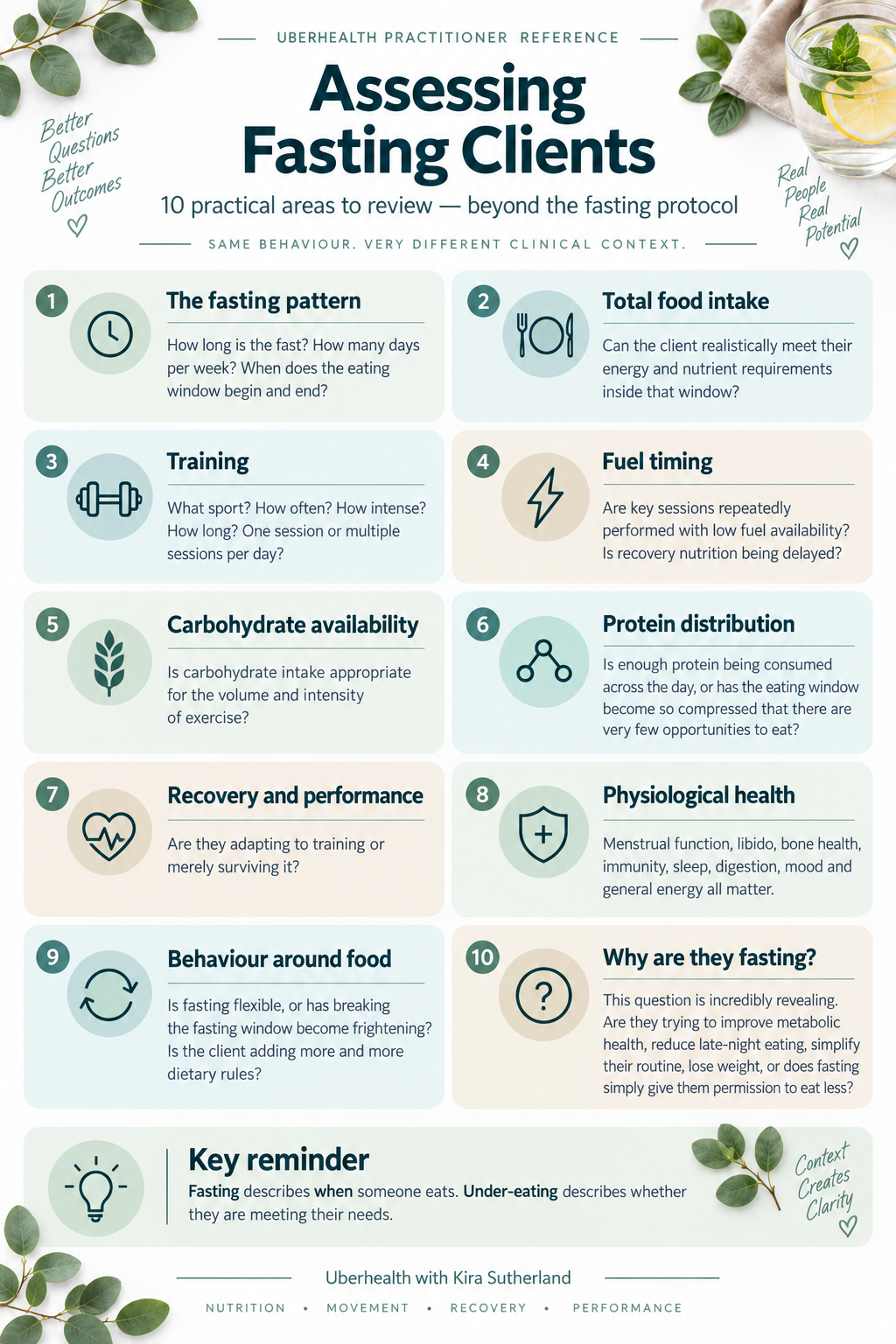
A practical way to assess fasting clients
When somebody is fasting, I like to look at several areas together rather than focusing on the fasting protocol itself:
1. The fasting pattern
How long is the fast? How many days per week? When does the eating window begin and end?
2. Total food intake
Can the client realistically meet their energy and nutrient requirements inside that window?
3. Training
What sport? How often? How intense? How long? One session or multiple sessions per day?
4. Fuel timing
Are key sessions repeatedly performed with low fuel availability? Is recovery nutrition being delayed?
5. Carbohydrate availability
Is carbohydrate intake appropriate for the volume and intensity of exercise?
6. Protein distribution
Is enough protein being consumed across the day, or has the eating window become so compressed that there are very few opportunities to eat?
7. Recovery and performance
Are they adapting to training or merely surviving it?
8. Physiological health
Menstrual function, libido, bone health, immunity, sleep, digestion, mood and general energy all matter.
9. Behaviour around food
Is fasting flexible, or has breaking the fasting window become frightening? Is the client adding more and more dietary rules?
10. Why are they fasting?
This question is incredibly revealing. Are they trying to:
- Improve metabolic health?
- Reduce late-night eating?
- Simplify their routine?
- Lose weight?
Or does fasting simply give them permission to eat less?
Same behaviour. Very different clinical context.
So what does well-tolerated fasting look like?
A client who is tolerating fasting well may have:
- good energy
- stable mood
- adequate total food intake
- appropriate carbohydrate intake for their activity
- sufficient protein
- good training quality
- normal recovery
- stable menstrual function where applicable
- good sleep
- no emerging pattern of recurrent injuries or illness
- flexibility around their eating window.
Their fasting pattern fits around their health and lifestyle. Their health and lifestyle are not being forced to fit around the fast. That distinction is important.
What does under-fuelling begin to look like?
I become more concerned when several of these start appearing together:
- the fasting window is progressively increasing
- meals are being skipped beyond the original fasting plan
- calorie and carbohydrate intake are falling
- training remains high or increases
- recovery worsens
- performance plateaus or declines
- persistent fatigue develops
- injuries become more frequent
- menstrual cycles change
- sleep deteriorates
- the client feels cold, dizzy or chronically depleted
- food rules become increasingly rigid.
One symptom doesn't tell us much. A pattern tells us considerably more.
Fasting doesn't cause REDs by definition
Fasting itself is not synonymous with REDs. A well-planned intermittent fasting strategy where energy and nutrient requirements are met is very different from chronic under-fuelling. Research in physically active adults indicates that intermittent fasting can sometimes be implemented without reductions in physical performance.
The issue is whether the fasting structure contributes to problematic low energy availability for that particular person. That's why blanket statements such as “fasting is bad for athletes” or “fasting is great for everyone” aren't especially useful. The answer is much more individual. Which, admittedly, is less exciting than a six-word Instagram headline. But it is much better clinical practice.
The question I keep coming back to
When a client tells me they are fasting, I don't ask them to stop, I start asking questions. And eventually it comes back to one very simple clinical question:
Is this fasting strategy helping this person meet their health goals, or is it making it harder for their body to get what it needs?
If energy, training, recovery, hormonal health and overall wellbeing remain good, fasting may fit perfectly well.
If those things begin deteriorating, the fact that the client has successfully maintained a 16-hour fasting window becomes considerably less impressive.
That is the difference between following a fasting protocol and practising individualised nutrition.
Want to go deeper into fasting in clinical practice?
My two-part webinar series 'The Science & Practice of Fasting' looks at:
- Traditional Fasting & Nature Cure, looking at the history, philosophy and different approaches used within naturopathic practice.
- Intermittent Fasting & the Modern Evidence, including time-restricted eating, different fasting structures, proposed metabolic effects and the individual factors that influence whether fasting may be appropriate.
And throughout both webinars, the focus comes back to what matters most in clinic: the method, the evidence and the person sitting in front of you.

FREE RESOURCE
PROTEIN & CARB GUIDE
